
Understanding NDOC Release Records
The Nevada Department of Corrections runs the state prison system and keeps records for people committed to its custody. NDOC is therefore the right agency for a sentenced Nevada state prisoner. It is not the custodian for someone whose only confinement was in a county or city jail. A federal sentence belongs in the Bureau of Prisons system, civil immigration detention belongs with ICE, and youth placements follow confidential juvenile channels.
That line matters after release. A name missing from a live jail roster does not turn the case into an NDOC case. Start with the agency that last held the person. For state custody, the official NDOC source gives access to Demographic, Alias, Booking, Parole, and Release data. A booking marks entry into NDOC custody. Parole records concern a supervised release mode. Release data describes a movement out of a placement. These categories are linked, but none can stand in for all the others.
The official NDOC home page identifies the agency behind the statewide prison record.
The agency branding helps distinguish an official Nevada corrections channel from local jail sites and unofficial name-search pages.
Use the NDOC Offender Search
The official NDOC offender search accepts an Offender ID or a demographic search. A demographic query uses first and last name, and the portal documents the percent sign as a wildcard. Use the ID when it is known because names, suffixes, aliases, and compound surnames can yield several candidates or hide a match. A photograph may aid identity matching, but it does not establish release.
The search page calls its output raw data. NDOC does not promise that it is error free and says it is not an official record. Keep the search date and copy the exact terms shown. If two dates conflict, do not choose the one that seems most likely. The conflict itself is a reason to contact NDOC or request the existing time and movement records.
- Open the official NDOC form and enter the Offender ID when available.
- For a name query, start with the full first and last name before using the documented wildcard.
- Compare date of birth, offender number, aliases, and physical description before selecting a record.
- Review booking, parole, and release data separately, then identify the latest dated movement.
- Record the release description exactly and follow any named supervision, transfer, or receiving agency.
The NDOC search form displays the search fields, wildcard note, warning, and five data categories together.
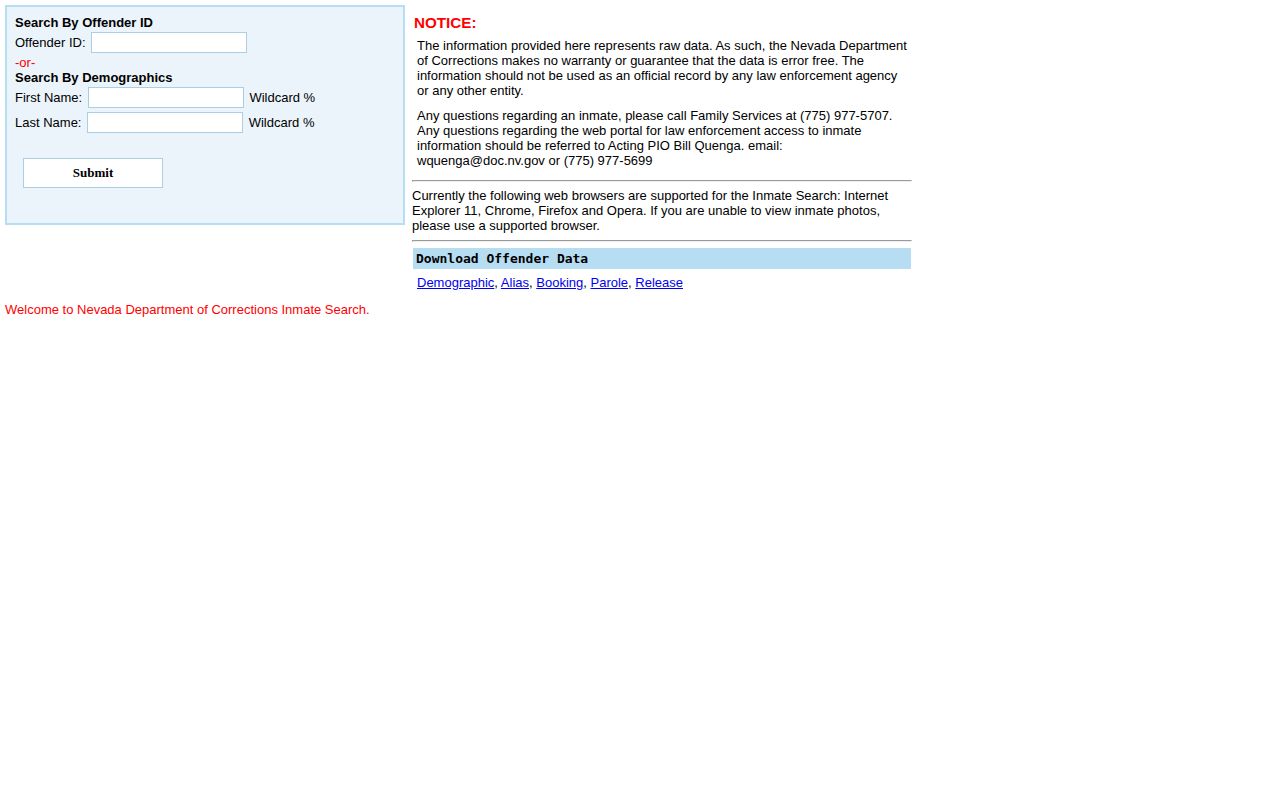
Those category labels provide a useful check against mistaking an old booking or parole entry for final discharge.
Note: A missing current institution proves only that the person is not displayed at that NDOC placement.
Read an NDOC Release Event
Some discharged people remain searchable in NDOC historical data. A live check on August 12, 2026 found official examples labeled INACTIVE-DSCHREL. One keyed Release row showed the description RELEASE FOR DISCHARGE. That confirms the portal can preserve a completed discharge event. It does not create a guaranteed online retention term, and the institution label alone does not reveal every detail of the exit.
The downloadable Release file uses the fields offender_id, offender_book_id, release_date, and release_desc. Join the two IDs before relying on a row. Then preserve the date and wording as published. NDOC descriptions can reflect parole, discharge, a court order, residential placement, transfer, or another event. A transfer ends one placement but may continue custody elsewhere.
| NDOC field or source | What it establishes |
|---|---|
| Offender ID | The durable NDOC identity key used to reconcile records. |
| Institution | The listed placement or inactive label, not the full legal disposition by itself. |
| Release date | The date attached to that NDOC movement event. |
| Release description | The agency's stated exit type or destination, which should be copied without broadening it. |
| Parole record | A supervision-related event that must be checked apart from final discharge. |
| Sentence dates | Eligibility and projected dates, not proof that the person physically left. |
The captured NDOC result view shows how exact status and release labels appear in the public interface.
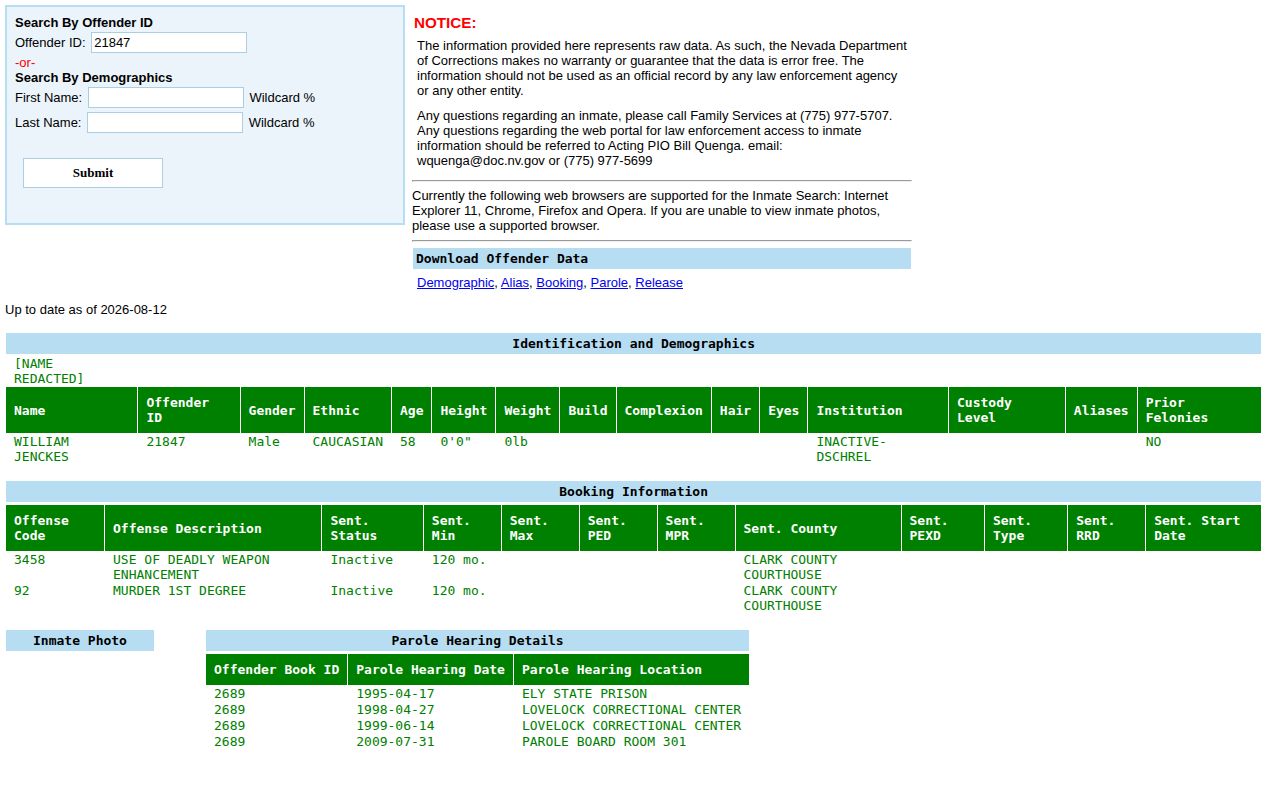
The wording should remain tied to the keyed record instead of being shortened to a vague claim that the person is free.
Nevada Release and Discharge Paths
Nevada uses indeterminate minimum and maximum sentences, eligibility rules, credits, Board decisions, and sentence expiration. Parole is conditional release from prison under Nevada Board of Parole Commissioners authority and NPP supervision. A Board grant is not a gate event. Timekeeping, the effective date, release planning, residence approval when required, and any holds still affect the movement.
Mandatory parole release, often shown as MPR in date material, is also supervised release under the statutory sentence framework. A discharge is different. NDOC sentencing definitions use DSC for completion of the prison sentence without community supervision needed, while DSCQ concerns discharge after a warrant is quashed. COR refers to a court-order release after a sentence change. PAR denotes parole, and DCE denotes death in custody. The actual Release description remains the controlling text for a specific event.
- Parole
- Conditional release from prison followed by supervision until discharge.
- Mandatory parole release
- A statutory supervised-release mechanism, not unconditional sentence completion.
- Discharge
- Completion or formal end of the controlling correctional stage described by the record.
- Detainer
- A hold or notice from another authority that can affect where the person goes next.
Residential confinement, transitional correctional placement, and conservation or work placement can allow activity outside a prison while correctional status continues. A county transfer into NDOC custody also is not community release. For parole, compare the Board action with the NDOC Release event and then verify current supervision through the Nevada State Police Division of Parole and Probation.
Nevada Release-Day Duties
NRS 209.511 supplies a specific statewide release-day framework for a person released by expiration, pardon, or parole. The Director may provide needs-based money up to $100. The word “may” and the cap both matter. Nevada law does not promise that each departing prisoner receives $100.
The same law requires suitable clothing and transportation cost to the person's residence within the continental United States or to the place of conviction. It also addresses a photographic identification card and reasonable DMV identification help under stated triggers, suitable transitional living placement, a 30-day supply of prescribed medicine, and benefit-enrollment paperwork under applicable conditions. These duties describe preparation and support. They do not identify the exact hour when an institution completes release processing.
For a case-specific plan, NDOC and NPP remain the proper sources. A planned ride, approved residence, or medication supply may be part of the file even when the public search shows only a brief movement description.
Note: “Up to $100” is a discretionary, needs-based cap and should never be stated as guaranteed Nevada gate money.
NDOC Release Statistics and Trends
NDOC's FY2025 fourth-quarter summary lists 4,248 actual releases from July 2024 through June 2025. The monthly totals comprise 3,670 male releases and 578 female releases. This is a flow count across a fiscal year. It is not a count of distinct people living without supervision, since a release event can lead to parole or another defined placement.
The December 31, 2025 quarterly summary reports 10,922 offenders at that point in time, including 10,593 in-house and 329 outside. That stock measure answers a different question. A current correctional population is not a historical release archive, which is why NDOC released-inmate research must use release events rather than a live head count.
| Published measure | Count | Meaning |
|---|---|---|
| 2019 release cohort | 5,963 | Historical cohort in the December 2025 NDOC series. |
| 2020 release cohort | 5,270 | A dated cohort, not a current custody count. |
| 2021 release cohort | 4,489 | The later cohort in the same published series. |
| FY2025 actual releases | 4,248 | Monthly release events from July 2024 through June 2025. |
| December 31, 2025 population | 10,922 | A point-in-time total, including in-house and outside statuses. |
The NDOC quarterly report archive organizes the dated source reports behind these measures.
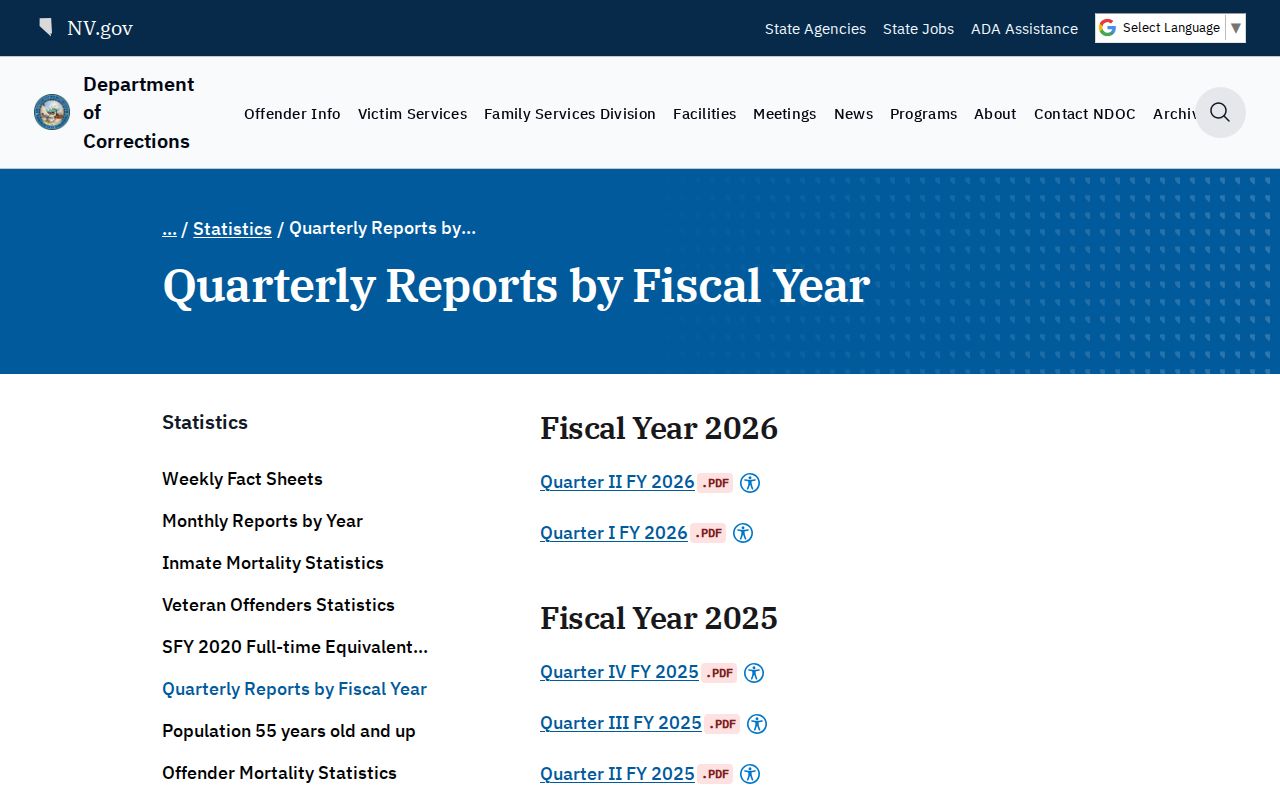
The decline across the cited 2019, 2020, and 2021 cohorts is visible in the official series, but the reports alone do not support a claim about its cause.
Nevada Sentence Dates and Credits
NDOC sentence data uses several labels that should never be merged. Sent. PEXD means Projected Expiration Date. It estimates the maximum sentence after projected credits, based on the assumption that future available credits will be earned. PED means parole eligibility date, NPED means next parole eligibility date, and MPR means mandatory parole release. None is an actual Release row.
Through June 30, 2027, NRS 209.4465 generally provides 20 days of credit for each month of qualifying service for eligible offenders who meet its conduct and duty requirements. Whether credits reach the minimum term depends on the offense and statutory exclusions. Nevada has no sound universal rule that every prisoner serves 85 percent. Offense date, category, fixed minimums, consecutive terms, prior-confinement credit, and earned or forfeited credits all matter.
Credits may be forfeited or restored under NRS 209.451, and some program credits can apply under NRS 209.448 or 209.449. A corrected judgment, aggregated sentence, later Board decision, or new sentence can also change the computation. The full Nevada date analysis is available through the Release Date Lookup.
NDOC Facilities and Release Status
NDOC operates prisons, conservation or work camps, and transitional correctional placements across Nevada. Florence McClure Women's Correctional Center, Ely State Prison, High Desert State Prison, Lovelock Correctional Center, Northern Nevada Correctional Center, and Southern Desert Correctional Center are among the prison locations reflected in statewide records. Casa Grande and the Northern Nevada transitional center remain correctional placements rather than proof of final discharge.
Closed or shuttered names can still appear in an old file. Nevada State Prison, Warm Springs Correctional Center, Silver Springs Conservation Camp, Southern Nevada Correctional Center, and several former camps should be treated as historical location keys. Do not direct a current custody question to a closed site. Use the official NDOC directory and historical data to reconcile the name.
The NDOC facilities directory displays statewide institutions and their current status.
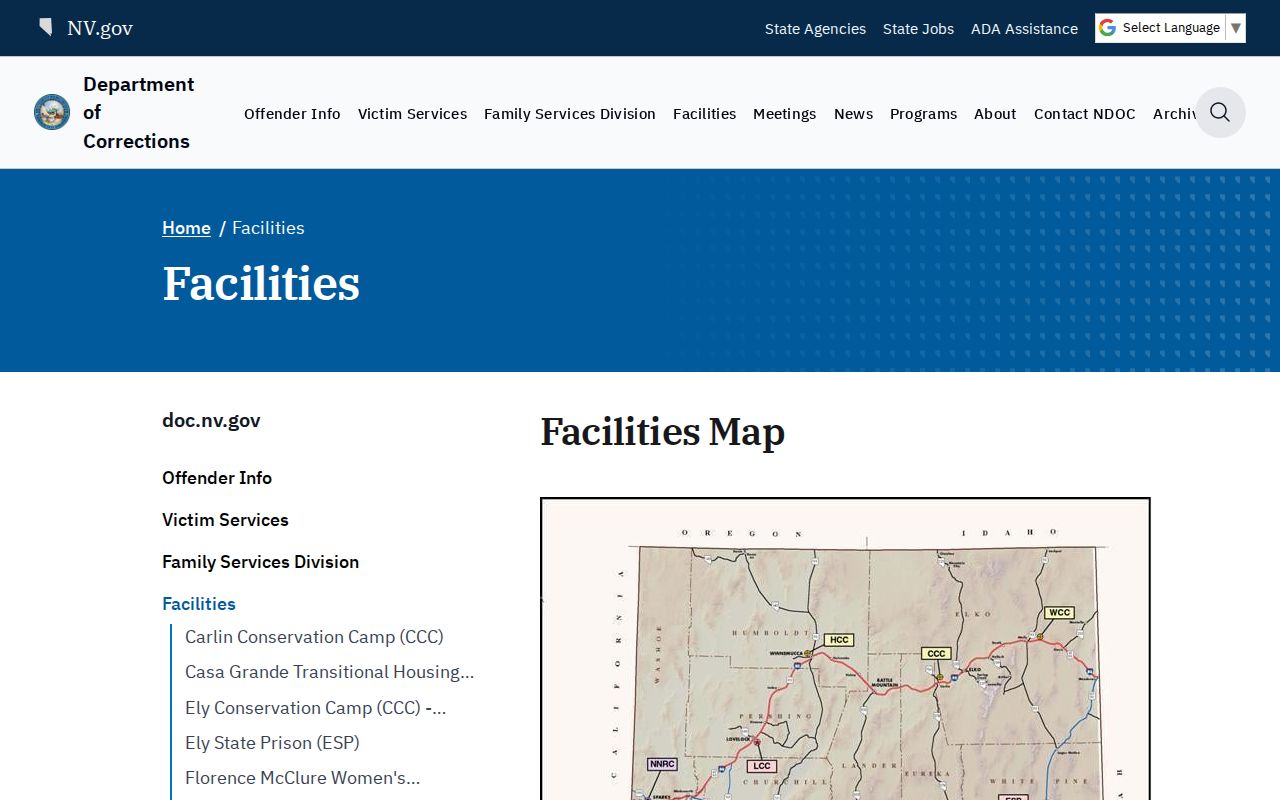
The facility label helps locate the former custodian, but only a dated Release event establishes the recorded movement.
NDOC and County Release Records
A state-prison record and a county-jail record come from different custodians. NDOC handles people committed to Nevada state prison. A county sheriff or municipal detention agency records a local release on bond, recognizance, dismissal, time served, court order, sentence completion, or transfer. Clark County also has distinct municipal systems, while some rural areas use temporary holds or outside beds.
| Custody path | Primary source | What to verify |
|---|---|---|
| Nevada state prison | NDOC offender search and records | Release date, release description, sentence data, and any parole. |
| County or city jail | Local sheriff or detention custodian | Actual exit or transfer entry, authority, and destination. |
| Federal sentence | Federal Bureau of Prisons | Federal status and release date, with other custody checked separately. |
| Immigration custody | ICE locator and assistance channels | Immigration custody status after any criminal handoff. |
If a county entry says “released to NDOC,” the person entered state custody. If NDOC says a person transferred to another authority, follow that authority. The statewide County Directory routes local-jail cases to the right locality without turning them into NDOC searches.
Request NDOC Release Records
The Nevada Public Records Act in NRS Chapter 239 generally requires an agency by the end of the fifth business day to provide the record, identify the proper custodian, cite withholding authority, or state when access is expected. That is a response deadline, not a promise that a large request is completed in five days. Sealed, juvenile, victim, medical, security-sensitive, and other protected material may be withheld or redacted.
Use NDOC's public-record form or email publicrecords@doc.nv.gov. The form routes to the Public Information Officer, 5500 Snyder Avenue, Carson City, NV 89701. The fee page lists inspection Monday through Friday from 8:00 a.m. to 5:00 p.m. and paper copies at 15 cents per page. A written estimate is issued when expected cost exceeds $25, and prepayment is required. Check the current page before filing.
A focused request should name the person and Offender ID, identify the approximate booking or release date, and ask for existing release or movement records, final sentence-computation material, or discharge documentation. Request the actual date, release description or destination, and supervision or discharge effective date when maintained and public. Electronic copies can reduce ambiguity and cost. The Offender Management Division route, omdrecords@doc.nv.gov and P.O. Box 7011, Carson City, NV 89702, is a separate offender-information channel.
Ask for identifiable records rather than an agency-created account of what happened. A narrow request is easier to route and less likely to require extraordinary use. Include a date range and the booking that ended near the disputed event. If parole was involved, the Board action and NPP discharge document may answer separate parts of the timeline. NDOC should not be asked to turn those distinct records into one unsupported legal conclusion.
The NDOC public-record fee page shows request mechanics and current agency contact details.
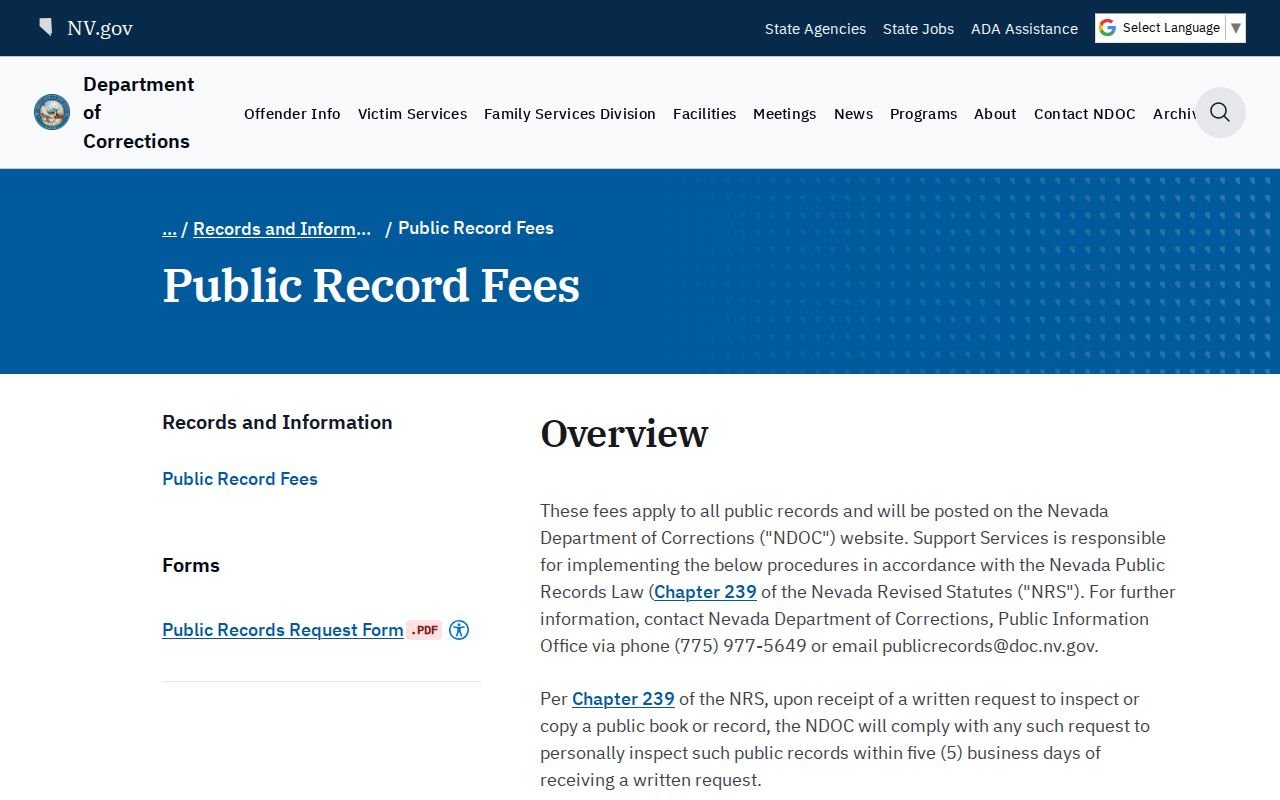
A record request supplies the best path when public fields conflict, a formal discharge document is needed, or the web search does not retain the event.
Note: Nevada generally uses record sealing, not a blanket expungement process, and a sealed item may no longer appear publicly.