
Nevada Projected and Actual Release
A projected date comes from the sentence as it is presently calculated. Nevada corrections staff begin with the judgment of conviction, the sentence start, minimum and maximum terms, credit for prior confinement, and directions on concurrent or consecutive terms. They then apply credits that are available under the governing law. The result can move as the sentence record changes.
An actual release is a dated movement. It can be release on parole, mandatory parole, expiration, a court-ordered change, residential placement, transfer, or another disposition. The exact description matters because leaving one institution may lead to supervision or a different custodian. A projected expiration date cannot prove that physical release occurred.
A person awaiting trial usually lacks a sentence-based date. Bail, recognizance, dismissal, a plea, a court order, and outside holds can all control the jail outcome. Ask the local jail timekeeper or court about that case rather than applying an NDOC state-prison formula.
Read Nevada NDOC Date Labels
The key NDOC label is Sent. PEXD, or Projected Expiration Date. Nevada sentence materials define it as the maximum term adjusted by applicable projected credits, on the assumption that future available credits will be earned. That assumption makes PEXD useful for planning but weak as proof of an exit.
PED is parole eligibility date. NPED is the next or later parole eligibility date. MPR is mandatory parole release. A PED can identify when the Board may consider release, while a Board grant can have a later effective date. MPR reflects a statutory supervised-release mechanism. None means final discharge unless an actual release and later discharge record supports that conclusion.
| NDOC label | Meaning | What it does not prove |
|---|---|---|
| Sent. PEXD | Projected maximum expiration after assumed future credits. | That all credits will be earned or release will occur that day. |
| PED | Parole eligibility date under the controlling sentence law. | That parole was granted or the person left prison. |
| NPED | Next eligibility point after a prior Board outcome or recalculation. | That the later hearing will result in release. |
| MPR | Mandatory parole release date within Nevada's sentence framework. | Unconditional completion of every legal obligation. |
| Release event | A dated NDOC movement with an official description. | Community freedom if the description names supervision or transfer. |
The captured NDOC sentence/date view places PEXD and related date labels in their official context.
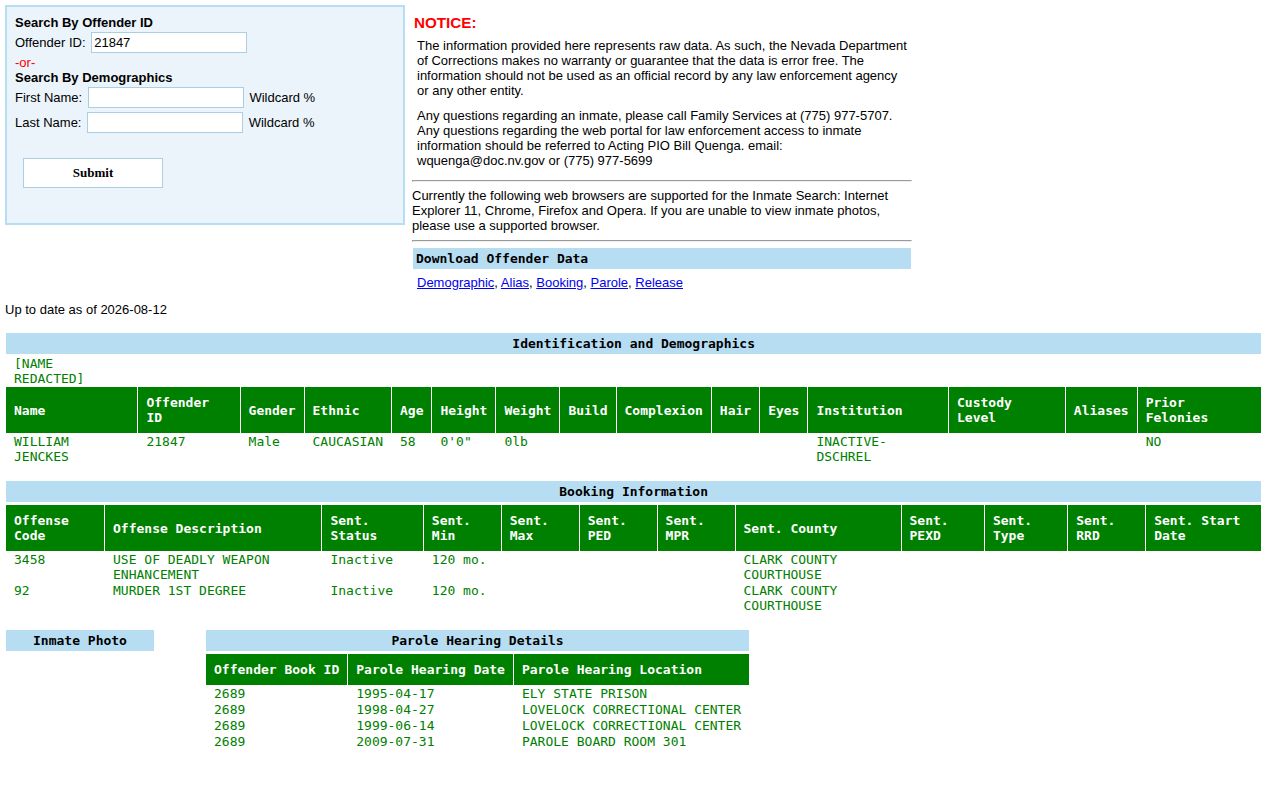
The display reinforces why the label beside a date is as important as the date itself.
Note: The Nevada Board of Parole Commissioners does not act as NDOC's sentence calculator.
Find a Nevada Projected Release Date
Use the official NDOC search for a person committed to Nevada state prison. An Offender ID is more reliable than a name because spelling, suffixes, aliases, and shared names can produce false matches. If only a name is known, begin with a full first and last name. The portal documents the percent sign as a wildcard, but broad use can return several people.
- Open the official NDOC offender-search form and enter the Offender ID when known.
- Confirm the record with date of birth, offender number, aliases, and physical description.
- Read Sent. PEXD, PED, NPED, and MPR as separate fields with separate purposes.
- Check Booking, Parole, and Release data to see whether a later event has overtaken the estimate.
- When the fields conflict, keep the query date and request the existing sentence-computation or movement record.
The official NDOC offender search shows the ID and name fields, wildcard instruction, raw-data warning, and linked record categories.
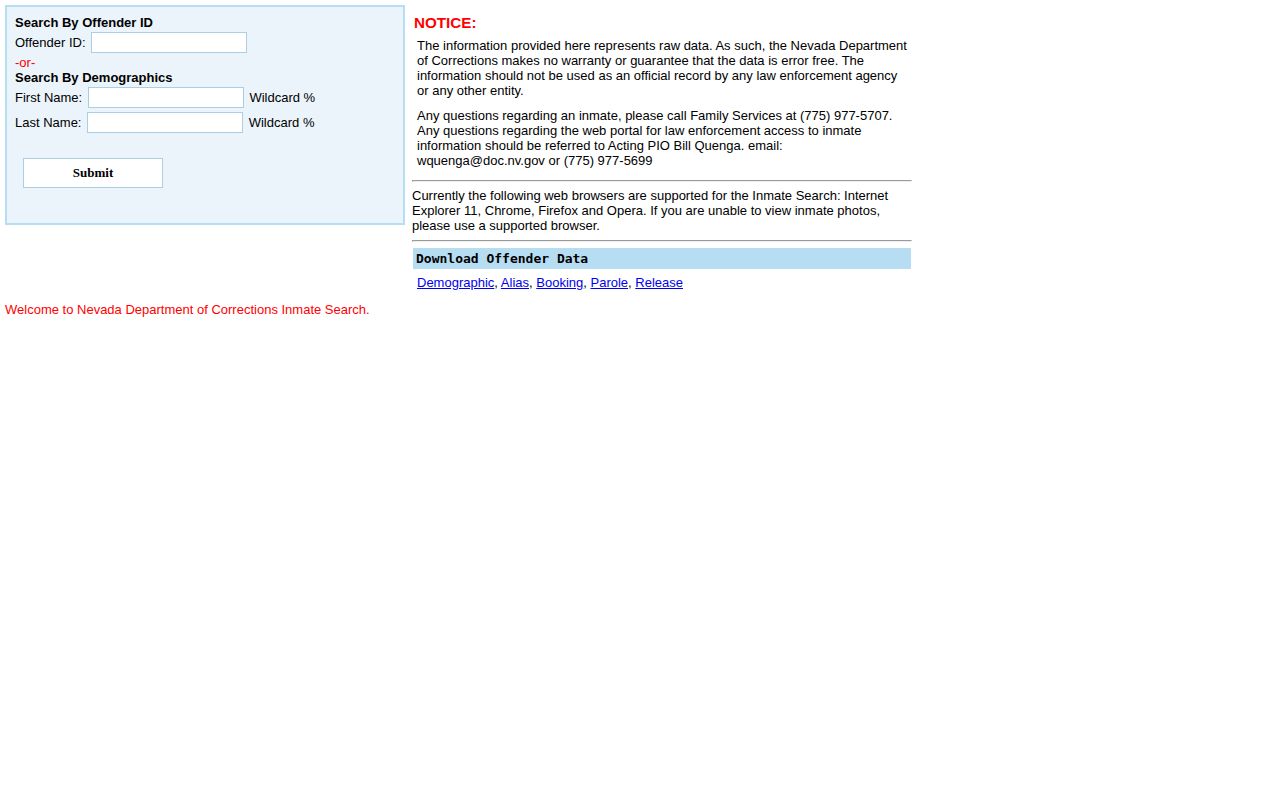
The form is a locator and reconciliation tool. NDOC warns that its raw public data is not an official record and gives no error-free guarantee.
A county or municipal sentence needs a different route. Contact the jail that holds the person and identify the court and case. County-jail credits are governed through NRS Chapter 211 and the local sentence computation. A local record saying “released to NDOC” means the person entered state custody, not that all custody ended.
Nevada Credits Through June 2027
Through June 30, 2027, NRS 209.4465 controls credits for many offenders sentenced for crimes committed on or after July 17, 1997. It generally provides 20 days of credit for each month of qualifying service when an offender has no serious infraction and performs assigned duties faithfully, orderly, and peaceably. Other provisions address diligence and educational achievement.
The application is not uniform. Subsection 7 ordinarily applies credits against the maximum term. Subsections 8 and 9 govern when credits can also reach the minimum term and parole eligibility. Listed exclusions include violent felonies, felony sexual offenses, specified felony DUI offenses, category A or B felonies, and a specified animal-cruelty offense. An offense law requiring a fixed minimum can also limit the effect.
| Credit issue | Potential date effect | Limit |
|---|---|---|
| Statutory service credit | Can reduce the projected maximum for qualifying service. | Eligibility and conduct rules still apply. |
| Minimum-term application | May affect parole eligibility where the statute allows. | Offense categories and fixed minimums can block it. |
| Program or education credit | Can alter a computation under the specific credit statute. | It is not automatic or universal. |
| Forfeiture | Can move the projection later after qualifying misconduct. | NDOC must apply the governing process and record. |
| Restoration | Can return some forfeited credit and revise a date. | Restoration is controlled by law, not presumed. |
NRS 209.451 covers forfeiture and restoration. NRS 209.448 and 209.449 contain program-credit routes that may matter in an individual computation. Those provisions do not create a fixed percentage for every Nevada prisoner.
Nevada Credit Law Changes in 2027
Nevada enacted NRS 209.4467 with an effective date of July 1, 2027. The Legislature also conformed NRS 209.4465 for offenses before that date and eligible elections. On the research date of August 12, 2026, the new framework was future law.
The difference is critical. A projected release date calculated in 2026 must not be explained with the future 35-percent framework as if it were already controlling. The current 20-days-per-month structure and its exclusions remain the starting point through June 30, 2027. After the transition, the official statute and the person's offense date, sentence, and any valid election must be checked again.
This date-stamped distinction is more accurate than saying Nevada follows a blanket truth-in-sentencing percentage. There is no sound one-line claim that each prisoner serves 85 percent. Sentence type, offense law, credit eligibility, fixed minimums, and the concurrent or consecutive structure all affect the result.
Why Nevada Release Dates Change
A projection can change even when the public record was accurate on the day it was viewed. Credits are earned over time, and future credits may be lost. Courts can correct judgments. NDOC can aggregate sentences or apply prior-confinement credit. The Board can deny, rescind, or later reconsider parole. A new sentence or warrant can add another controlling legal event.
| Change | Likely effect | Best confirming source |
|---|---|---|
| Credits earned | The projected expiration may move earlier. | NDOC time-computation record. |
| Credits forfeited or restored | The date may move later or earlier. | NDOC disciplinary and computation records. |
| Corrected judgment | Minimum, maximum, or start calculations may change. | Sentencing court and NDOC computation. |
| Consecutive or aggregated sentence | A later controlling term can extend the projection. | Judgments and NDOC sentence record. |
| Parole action | Eligibility or effective timing may change without immediate release. | Board action plus NDOC Release event. |
| Detainer or outside hold | The planned movement may become transfer to another authority. | NDOC movement record and receiving agency. |
The Nevada parole hearing archive shows monthly schedules and eligibility-list routing.
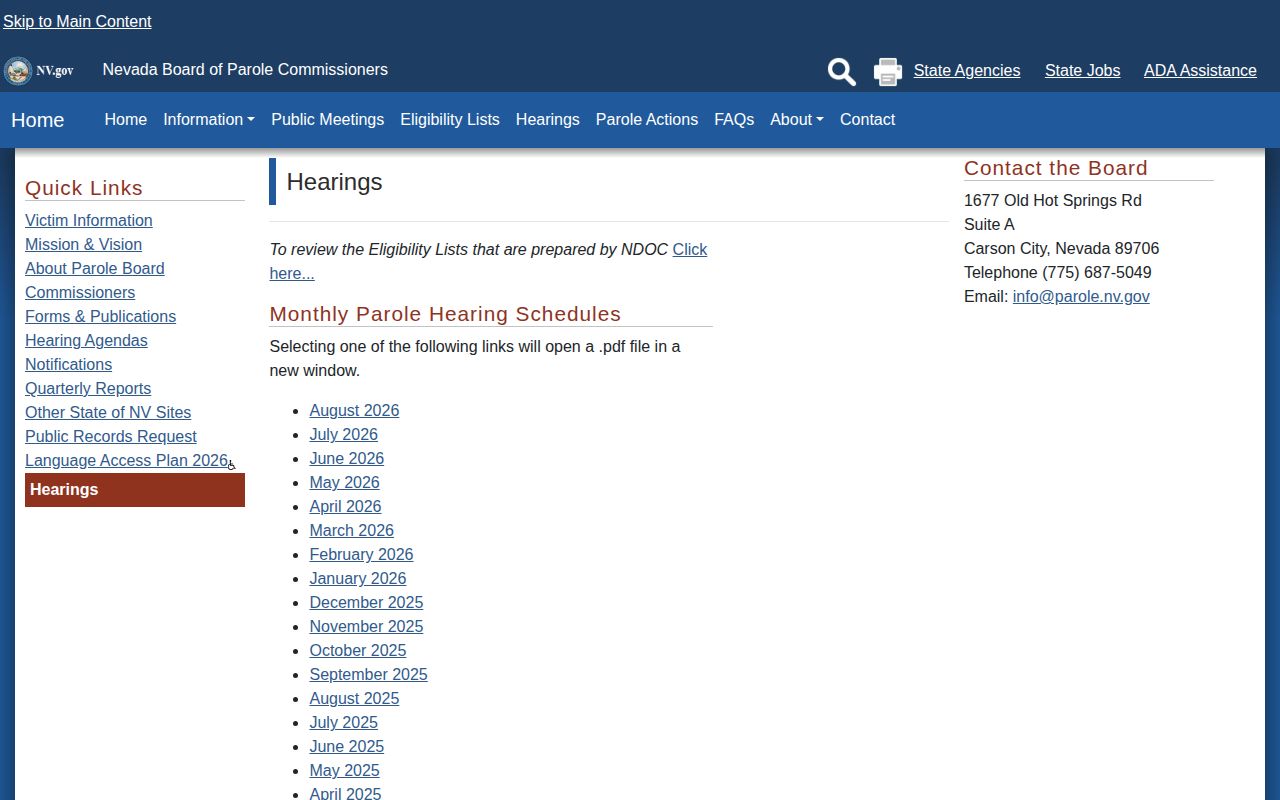
A hearing schedule is a planning record. It does not prove a grant, an effective movement, or the person's actual release date.
Note: A detainer may change the destination even when NDOC completes its planned release movement.
Nevada Parole Dates Are Not Gate Dates
The Nevada Board of Parole Commissioners publishes schedules and Monthly Parole Board Actions. Those records answer eligibility and decision questions. Report fields can include NDOC ID, offender name, location, commit county, action, action date, and effective or denied-to date. A favorable action can still carry a future effective date.
Release planning comes next. NDOC timekeeping must confirm the sentence date, the decision must become effective, a residence or plan may need approval, and holds must be resolved. The actual NDOC movement is a separate event. If the event is parole, Nevada State Police Division of Parole and Probation supervision follows until discharge.
The Monthly Parole Board Actions archive also warns that hearings near month end may not appear in that month's report.
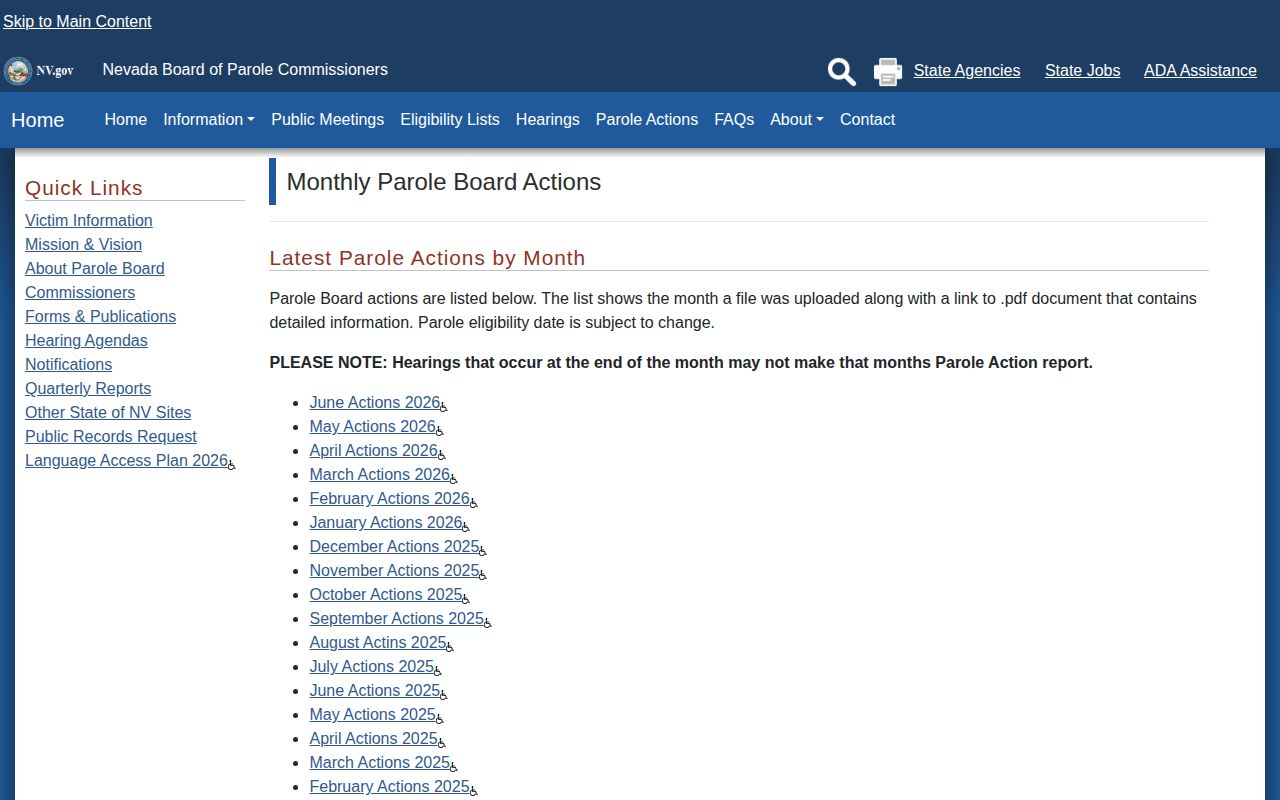
Search both the relevant and following report, then compare any action with the later NDOC Release record.
Nevada Time-Calculation Release Records
A public date can be too brief to explain a complex Nevada sentence. When the number does not match the judgment or a prior result, request the existing time-computation record instead of asking NDOC to create a fresh legal analysis. A focused request identifies the person, Offender ID, sentencing court, case number when known, and the date range in dispute. It can seek the current sentence computation, credit entries, movement record, and the final discharge record if release has occurred.
Nevada's Public Records Act, NRS Chapter 239, generally requires an agency by the end of the fifth business day to provide the record, identify the right custodian, cite the legal basis for withholding, or state when access is expected. That rule concerns the agency response. It does not guarantee that a complex production will be finished in five business days. Confidential, sealed, medical, security-sensitive, juvenile, and other protected material can be withheld or redacted.
NDOC accepts a public-record form and requests at publicrecords@doc.nv.gov. Its published fee schedule lists inspection on weekdays, paper copies at 15 cents per page, and a written estimate with required prepayment when expected cost exceeds $25. Current details should be checked before submission. Offender Management Division also publishes omdrecords@doc.nv.gov for an initial offender-record inquiry. Keeping the request narrow helps the agency locate the right computation without confusing it with a general web-search question.
If the sentence is local, send the inquiry to the county jail timekeeper and use the sentencing court's judgment. NDOC cannot certify a county-jail computation. Likewise, the Parole Board can confirm its own action but does not replace the corrections timekeeper. Each source should answer the part of the date sequence it owns.
Note: A five-business-day public-record response rule is not a five-day guarantee for final production.
Confirm a Nevada Actual Release
After a projected date passes, look for an actual Release event. The NDOC data separates Release and Parole records, so inspect both instead of relying on an inactive institution label. Record the actual date and the agency's full release description. If the description indicates supervision, residential placement, transfer, or a hold, follow the next custodian or supervising agency.
The NDOC Offender Search explains how to reconcile the public historical files and request formal movement or discharge records. Family Services is NDOC's published public-question route at 775-977-5707. A focused records request can seek the existing time-computation, movement, or discharge record when the public fields conflict.
NV S.A.V.E. can add a timely alert. Nevada replaced legacy VINE with the offender-based service in August 2025. A registration can follow an offender across participating Nevada custody or supervision agencies. Alerts are prompts to verify, not official NDOC records, because transmitted data may not be audited before it reaches the service.
The current NV S.A.V.E. portal provides Nevada offender search and notification registration.
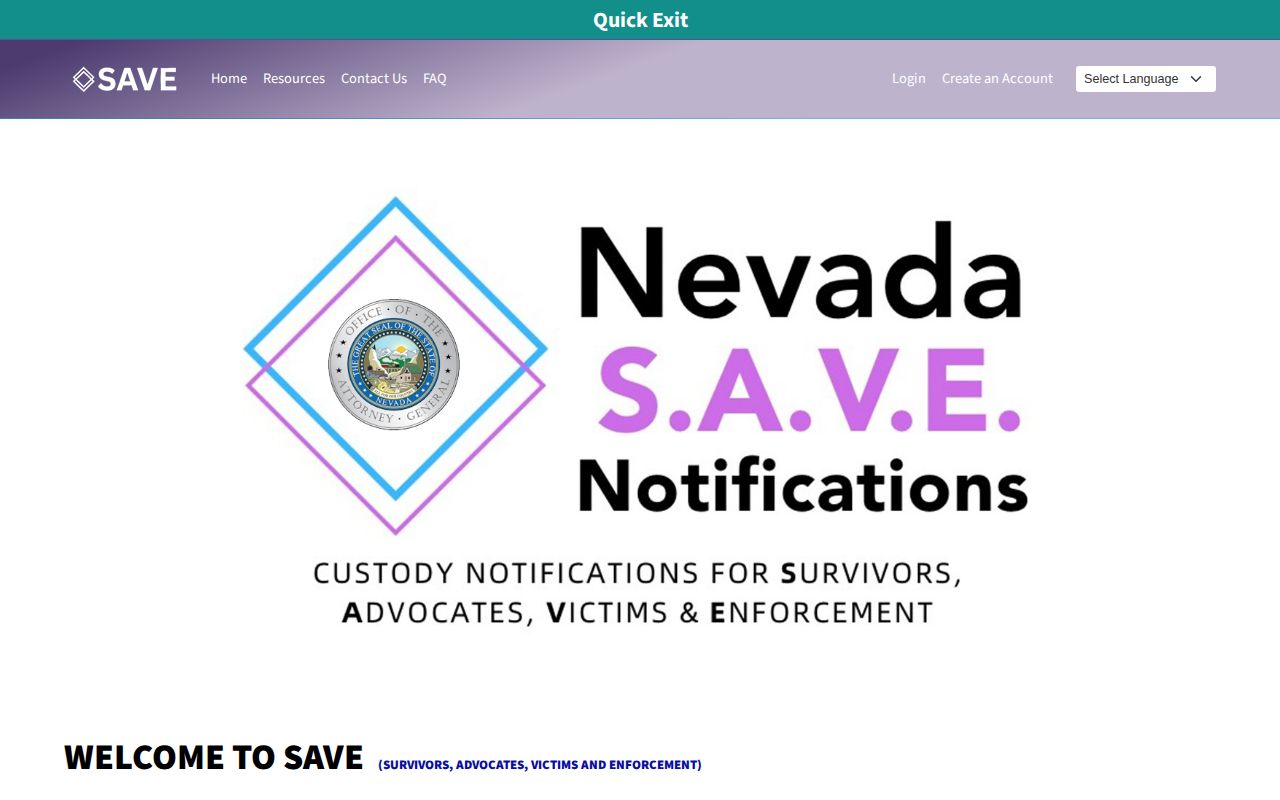
The portal can help track a pending change, while the custodian's movement record remains the stronger source for the completed event.
For ongoing alerts and the August 2025 VINE transition, use the VINE Inmate Check. For a county sentence, the local jail and sentencing court must confirm the calculation and actual exit. For a federal sentence, use the Bureau of Prisons locator. An ICE handoff requires the ICE locator and assistance channels because “released to ICE” is a transfer, not community release.