
Nevada Parole Board Records
The Nevada Board of Parole Commissioners is the decision-maker for state parole. It publishes hearing schedules and Monthly Parole Board Actions for different points in the process. NDOC prepares eligibility information and maintains the prison, sentence, and movement records. NPP investigates release plans and supervises a person after parole starts. Keeping those roles apart prevents a scheduled hearing from being reported as a grant or a grant from being reported as an actual release.
A hearing is a review event. It commonly occurs before the minimum eligibility date so that later planning can take place, but it is not a gate date. The Board does not serve as NDOC’s sentence calculator, and a calendar does not override timekeeping. If NDOC later finds a new ineligibility issue or a transfer changes the case, a name can be removed and rescheduled when NDOC submits it again.
The official Nevada hearing hub shows the month-by-month archive and the path to NDOC eligibility lists. This source capture reflects the schedule structure that should be checked live.
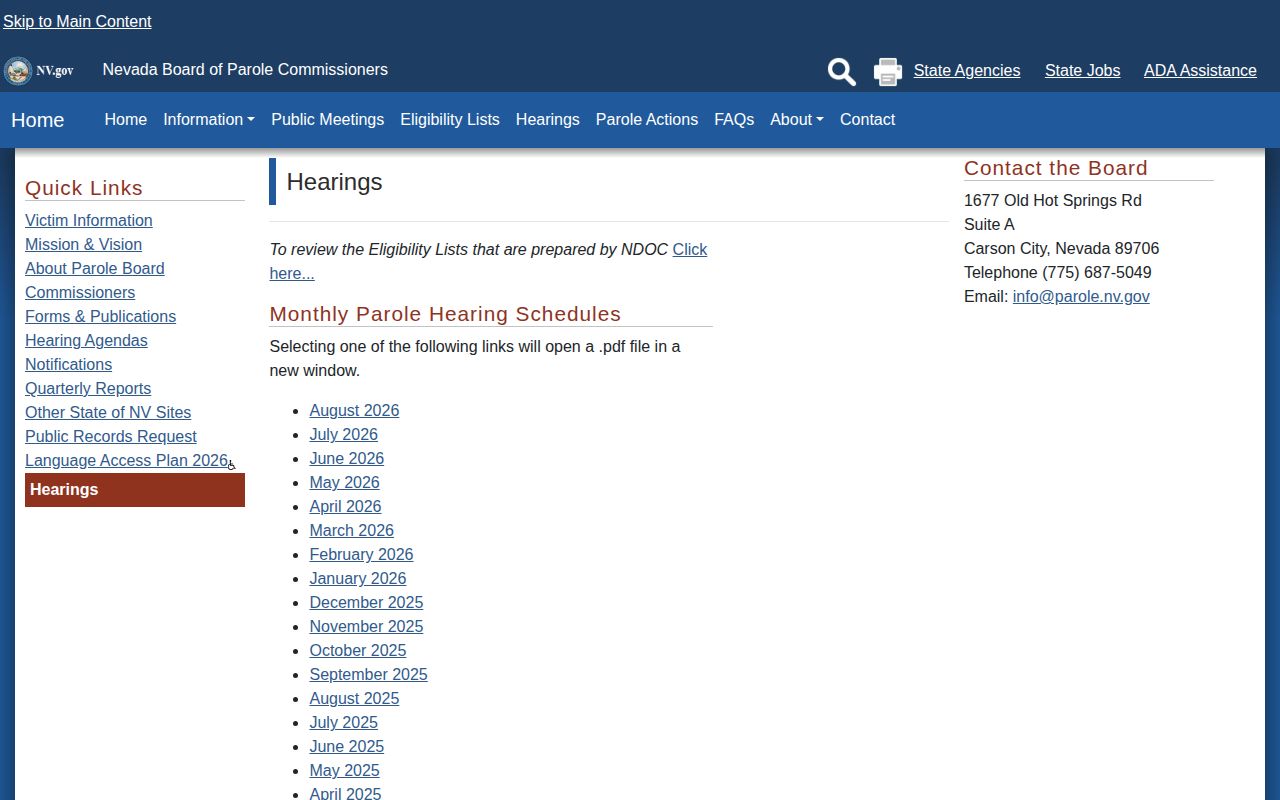
Because the archive rolls forward, record the date checked and open the current posting rather than relying on a saved month label.
Find Nevada Parole Hearing Dates
The schedule page states that agendas are posted as soon as they are finalized and approved for distribution. It does not promise a fixed weekday or a guaranteed lead time. Amended agendas may follow. Search the live month that fits the person’s eligibility window, but also check the month before and after if the expected name is absent.
The NDOC Monthly Eligibility List and the Board schedule are related but not interchangeable. Eligibility data supports who may be ready for review, while a finalized agenda supports the hearing setting that was approved for distribution. If a name appears on an eligibility list but not the expected agenda, check for an amendment, transfer, new ineligibility finding, or later resubmission. Do not report the eligibility-list month as the hearing date.
- Use the NDOC offender search to confirm the person’s name, Offender ID, institution, and date fields such as PED or NPED.
- Open the Board’s hearing hub and choose the relevant monthly schedule PDF.
- Search the PDF for the surname, then confirm the Offender ID or other available case details instead of relying on the name alone.
- Read the schedule entry and check whether an amended agenda was posted for that month.
- If no entry appears, examine the NDOC Monthly Eligibility List and nearby Board months. A transfer or new eligibility finding can lead to removal or rescheduling.
- Return after the hearing to the separate Monthly Parole Board Actions archive. The schedule itself is not the decision.
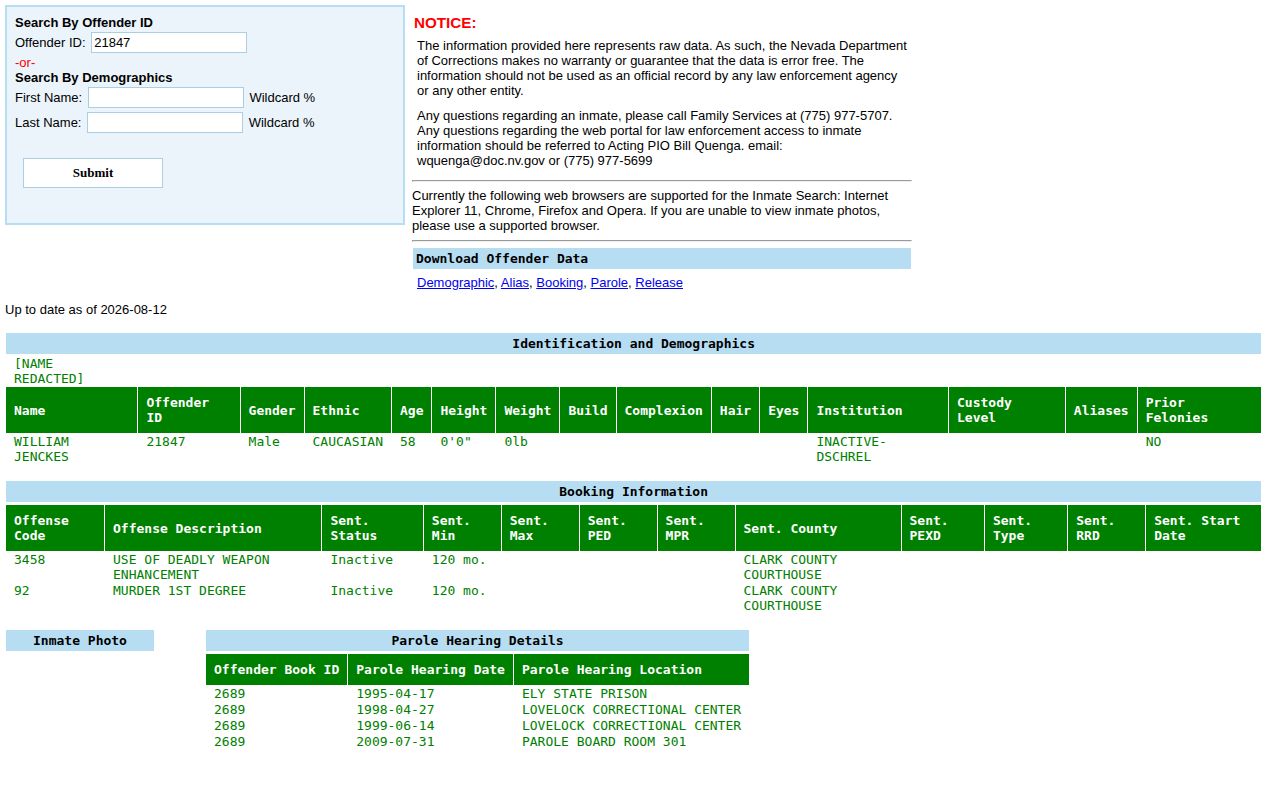
The NDOC offender search supplies the identifier and the separate data categories used in this match.
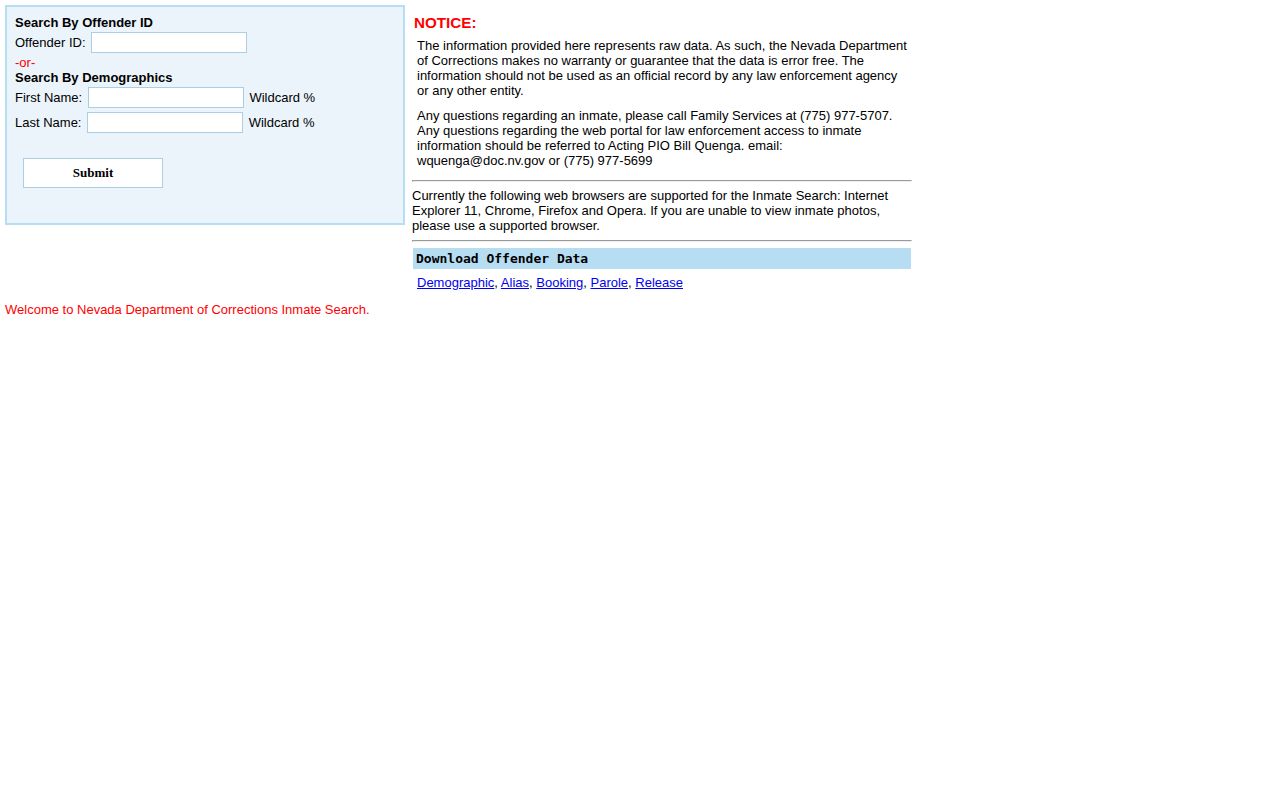
The portal calls its information raw data and does not guarantee that it is error-free, so an official record request is the fallback for a material conflict.
Nevada Parole Eligibility Lists
Eligibility begins with the sentence, not the calendar. Nevada’s framework appears in NRS Chapter 213, including NRS 213.120 through 213.12135. For many post-July 1, 1995 indeterminate sentences, the court-imposed minimum or minimum aggregate is the main starting point, subject to offense rules, aggregation provisions, and statutory limits. Credits affect the minimum only where controlling law allows them.
NDOC date abbreviations answer different questions. PED is a parole eligibility date. NPED is a next parole eligibility date. MPR refers to mandatory parole release. Sent. PEXD is projected expiration based on the maximum sentence and projected credits. None of those labels is an actual Release event. A person can reach a hearing stage but still have planning, a hold, or another legal step before movement.
The official NDOC sentence-date view provides the source context for Sent. PEXD and related parole date labels.
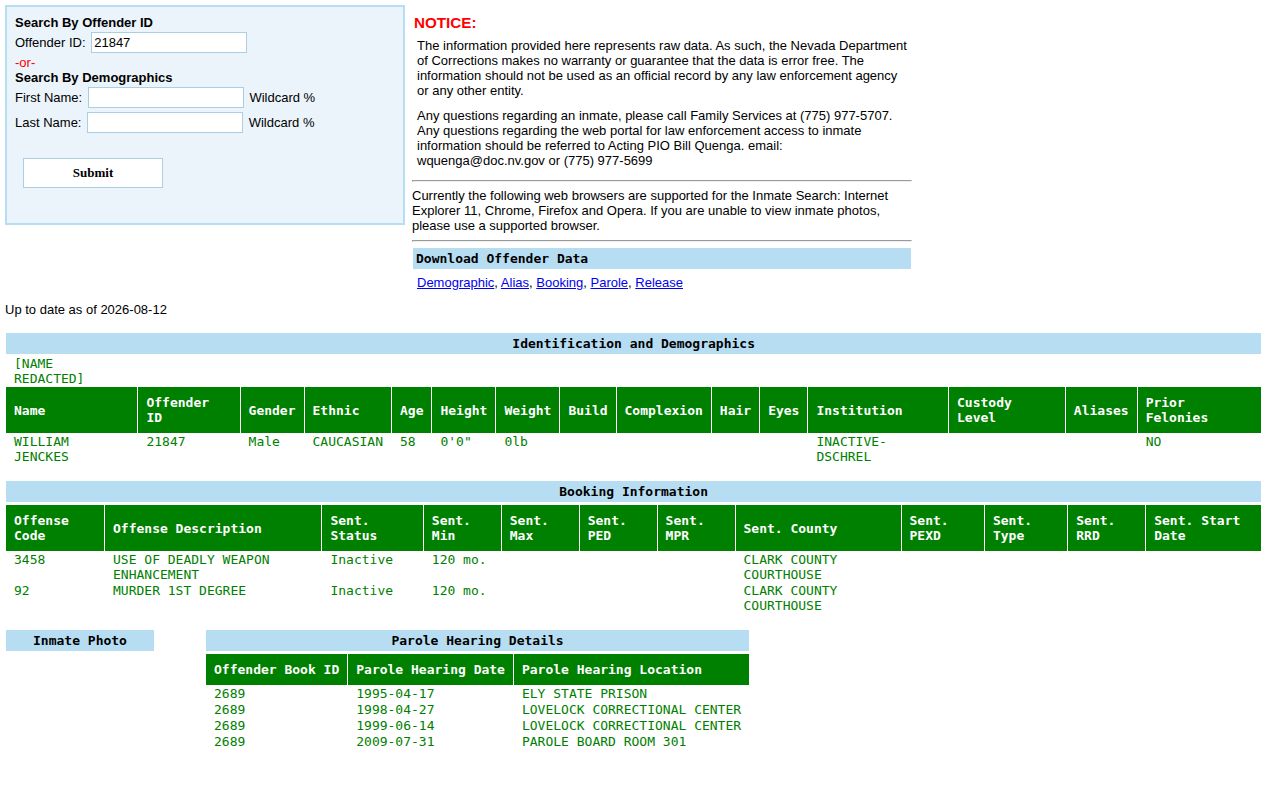
Read the label before using the date. Converting PED or PEXD into a promised release date is a substantive error.
Note: Nevada does not have one sound rule that every prisoner serves a fixed percentage before parole review.
Find Nevada Parole Board Actions
Results appear in the Board’s Monthly Parole Board Actions PDFs. They are not an interactive statewide name database. Each published row can contain NDOC ID, offender name, location, commit county, action, action date, and an effective or denied-to date. Search by a confirmed surname and identifier, then preserve the Board’s exact action language.
- Open the Monthly Parole Board Actions archive after the scheduled hearing month.
- Download the relevant PDF and use text search for the surname or NDOC ID.
- Check the following month as well. The archive warns that a hearing near month-end may not appear in that month’s report.
- Match the location, commit county, action date, and identifier before attributing the action.
- Copy the action and effective or denied-to field as written. Do not shorten a qualified outcome into “released.”
- Move to NDOC Release data for physical movement and to NPP for supervision after release.
The actions source shows the PDF archive and its month-end warning.
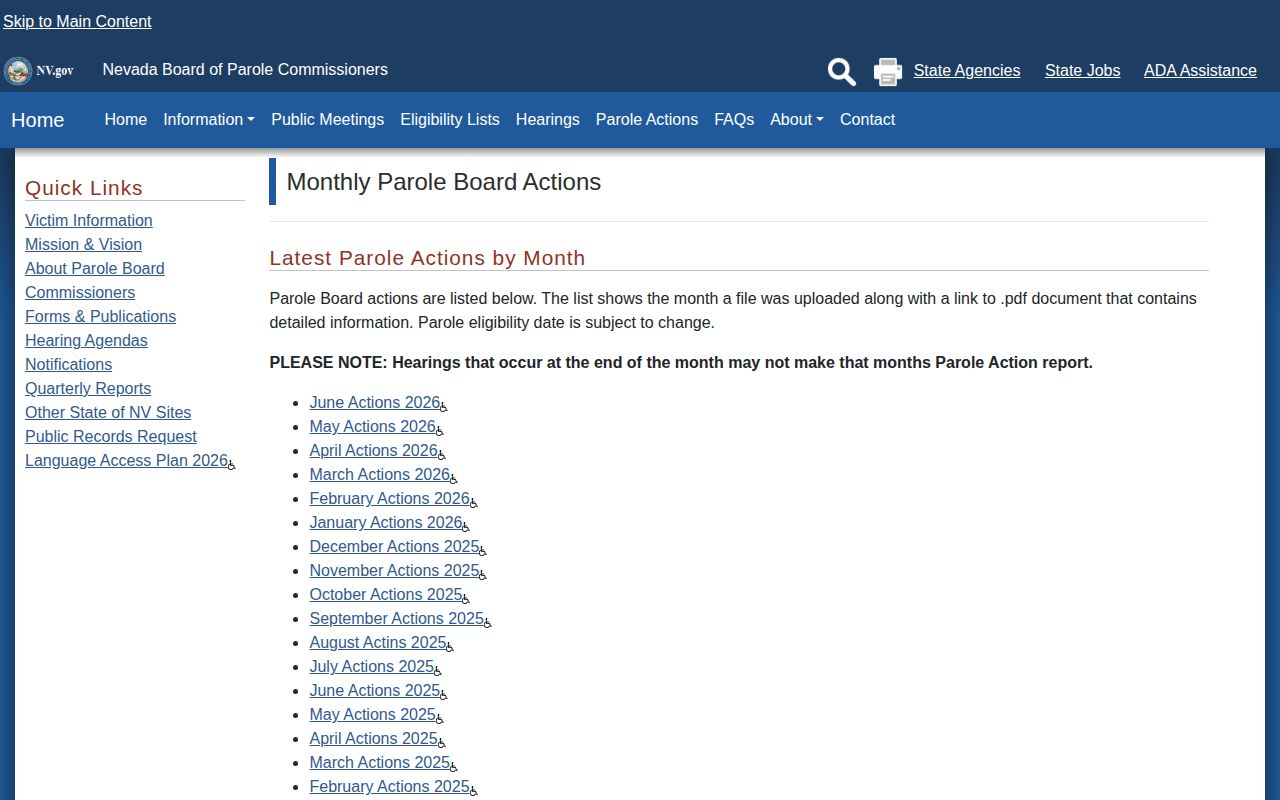
Checking two report months is often the difference between a true no-result and a report-timing miss.
Nevada Parole Hearing Outcomes
The action field must control the summary. Nevada reports include language such as Grant Parole, Deny Parole, Grant MPR, Deny MPR, Grant Early Discharge, Revoke Parole, Revoke MPR, Revoke & Reinstate, limited-day revoke and reinstate actions, and No Action. A final field can also state TO EXPIRATION or NO ACTION. These terms describe different legal results and should not be forced into a simple yes-or-no label.
| Outcome | What the record supports | Next check |
|---|---|---|
| Grant Parole or Grant MPR | A favorable Board action, often with an effective date | Release planning, holds, and the NDOC Release event |
| Deny Parole or Deny MPR | Release was not approved through that action | Read the denied-to date or next eligibility information |
| Continued, deferred, or rescheduled | The matter was not finally resolved on the expected schedule | Amended agenda, a later schedule, and a later action report |
| Revoke or revoke and reinstate | A violation outcome affecting a person already on parole | Violation action, custody movement, and NPP status |
| Rescinded or changed action | A later official action controls over an earlier expected result | The newest Board record and NDOC movement data |
| No Action or TO EXPIRATION | The report does not support a new parole release grant | Sentence and expiration records from NDOC |
A grant is not the same as release. NDOC still handles timekeeping and movement, a release plan or residence may need approval, and another hold can control. A denial also should not be paraphrased beyond the document. Use the denied-to date or later eligibility record instead of guessing when review will occur.
Revocation language belongs to a post-release case, not an initial request for parole. Likewise, an early-discharge action concerns the possible end of supervision rather than the first exit from prison. Location and commit-county fields help identify the correct row, but the NDOC ID remains the stronger match when names repeat. Each field should be carried into the next agency check instead of reduced to a one-word status.
Nevada Grant to Release
The strongest Nevada verification chain begins with eligibility, then moves through the schedule and action. It ends with an actual movement and, for parole, field supervision. This order answers five separate questions: when review became possible, when review was set, what the Board decided, whether NDOC released the person, and whether NPP now supervises the parole.
NDOC’s official data separates Booking, Parole, and Release records. A Release row carries a date and description or disposition. If that language describes parole, residential placement, transfer, or another authority, it should be preserved. Leaving one NDOC institution does not always mean unconditional community release. Likewise, an inactive label needs the linked event data before the exit type is stated.
The official NDOC released-result source demonstrates the exact status and release labels that follow the Board stage.
The movement record should then be paired with NPP supervision rather than treated as final sentence discharge.
Nevada Parole Violation Hearings
A parole violation hearing has a different purpose from an initial parole review. It concerns alleged violations after release. A panel may continue the case or take a revocation-related action under the governing process. Condition-modification, lifetime-supervision, and early-discharge calendars can also concern someone already outside prison. None should be reported as a new prison release without a matching custody event.
The Board’s parole violation hearing page is the right calendar source for that process. After the hearing, use the action report and then check NDOC or NPP according to the outcome. An alleged violation is not a final finding, and a wanted notice is not a complete case record.
For field status after a grant or violation outcome, the Nevada post-release supervision page explains NPP office routing, confidentiality, and discharge proof.
Nevada Clemency and Pardons
Nevada’s pardons and paroles law separates executive clemency from ordinary Board parole. A pardon or commutation follows the constitutional and statutory clemency process connected to the Board of Pardons Commissioners. It is not found by reading a monthly parole action as though that report were a court dismissal or a complete clemency record.
The distinction changes the search. For parole, use the hearing schedule, Monthly Parole Board Actions, NDOC movement data, and NPP supervision. For a pardon or commutation, use the clemency authority and the record of its action, then check NDOC and court records for the practical effect. Do not assume that clemency removes every public record or rewrites the historical booking and case files.
NRS Chapter 213 is the official statutory starting point for both subjects, but the decision paths remain separate. A purpose-neutral summary should name the exact relief, effective date, and issuing body. It should not substitute “parole granted” for “pardoned,” or “commuted” for “case dismissed.”
Note: Clemency can affect a sentence without making every related arrest, court, or correctional record disappear.
Resolve Nevada Parole Conflicts
A missing PDF result may reflect timing, an amended schedule, rescheduling, a spelling issue, or a different report month. A favorable action with no NDOC Release event may reflect a future effective date, plan approval, a hold, or processing. A release event with no active Nevada supervision result may require NPP office routing, an Interstate Compact inquiry, or final discharge proof. These are reasons to keep searching, not reasons to invent a status.
When public sources truly disagree, preserve the Offender ID, exact labels, dates, PDF month, and query date. Ask the originating custodian for the existing record. NDOC calls its offender portal raw data, while Board PDFs document their own action layer. The current record from the agency responsible for the disputed stage should receive the most weight.
The sequence protects both accuracy and dignity. It distinguishes a scheduled review from a final action, a favorable action from a prison exit, and a prison exit from the end of supervision.
Public Record Search
Sponsored Results