
Nevada Parole and Probation
Parole is a conditional release from prison under the authority of the Nevada Board of Parole Commissioners. The person has left the prison placement but remains under the sentence and is supervised in the field. Probation is imposed by a court. It can begin without any Nevada Department of Corrections prison term, so finding probation does not prove that the person was released by NDOC. The Nevada State Police, Division of Parole and Probation, known as NPP, handles field work for both groups while the legal source of each status remains distinct.
The agency roles matter when records conflict. The Board supports a parole decision. NDOC supports the actual prison movement. NPP supports current field supervision. A sentencing court supports probation and later court action. No single screen replaces all four. The comparison below keeps a Nevada supervision check tied to the right source.
| Status | How it begins | Primary proof | Who supervises |
|---|---|---|---|
| Parole | Board action followed by an NDOC release | Board action, NDOC Release event, and NPP confirmation | NPP |
| Mandatory parole release | A statutory sentence mechanism | NDOC date and movement data plus NPP status | NPP |
| Probation | District, Justice, or Municipal Court order | Judgment, docket, and NPP office confirmation | NPP |
| Discharge | Completion or lawful early end of supervision | Official discharge document and controlling action | No active field supervision after effective discharge |
The Monthly Parole Board Actions archive shows the official decision layer. The source view illustrates how Board actions are organized before they are reconciled with an NDOC movement.
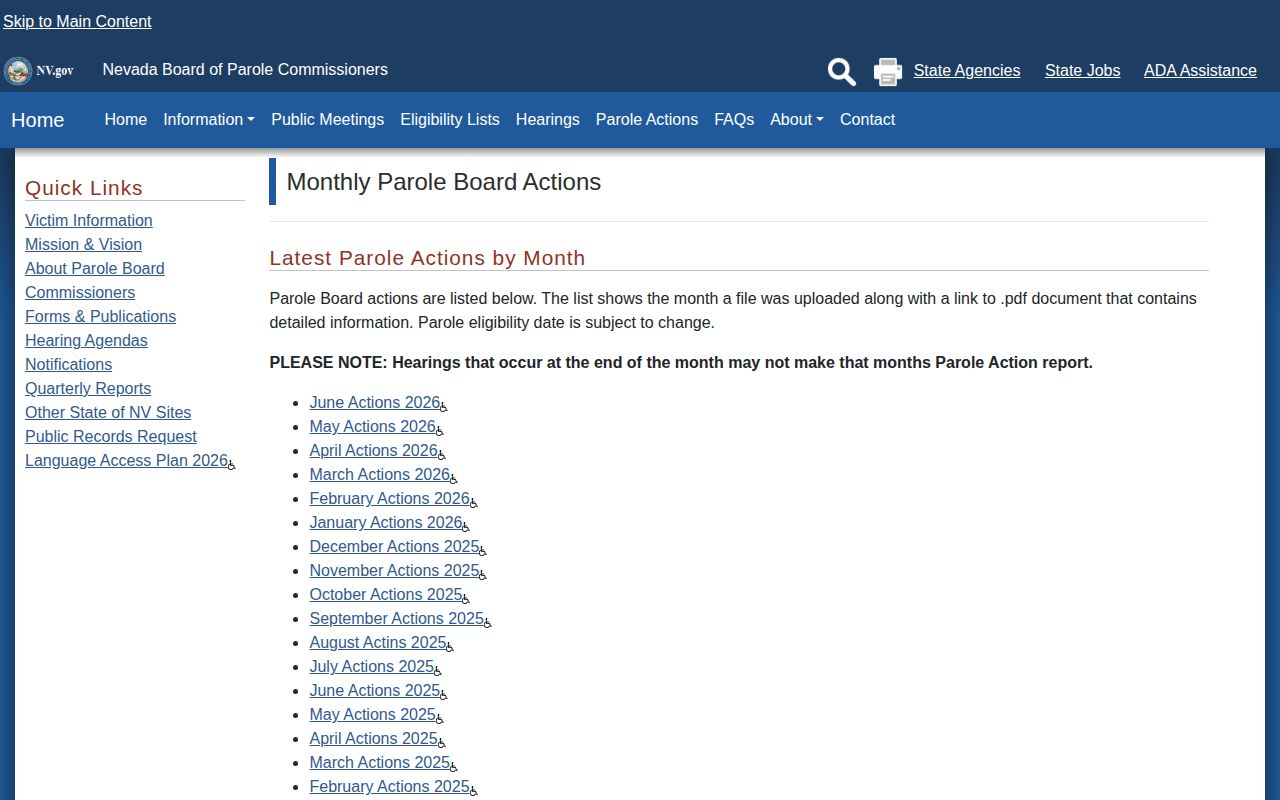
A favorable action may have a future effective date. It should not be read as proof that a person has already left prison.
Check Nevada Post-Release Supervision
There is no broad public NPP directory that works like the NDOC offender search. Verification therefore uses an evidence chain. Start from the source most likely to identify the sentence, then ask NPP to confirm the correct office and any status it may lawfully disclose. NRS 213.1075 generally makes information gained by Division and Board staff in their duties privileged unless an authorized exception applies. That rule is why a public office may confirm less than a person expects.
- Identify whether the case is parole or probation. Use the NDOC Offender ID and Board material for parole, or the sentencing court and case number for probation.
- For parole, find the relevant monthly Board action and note the action date, effective date, and exact outcome.
- Confirm an actual NDOC Release event. A grant, PED, NPED, or other date is not a physical movement record.
- Use the NPP office directory to route the inquiry by the believed Nevada county of residence.
- Provide the full name, date of birth when appropriate, Offender ID, sentencing court or case, and known county. Ask whether the office is correct and what status can be confirmed.
- If the person moved through the Interstate Compact, ask which state holds sentencing authority and which state performs field supervision.
The official NDOC offender search supplies the Offender ID and separates Parole and Release data from Booking data. This captured search shows the fields, wildcard instruction, and raw-data caution that apply before NPP is contacted.
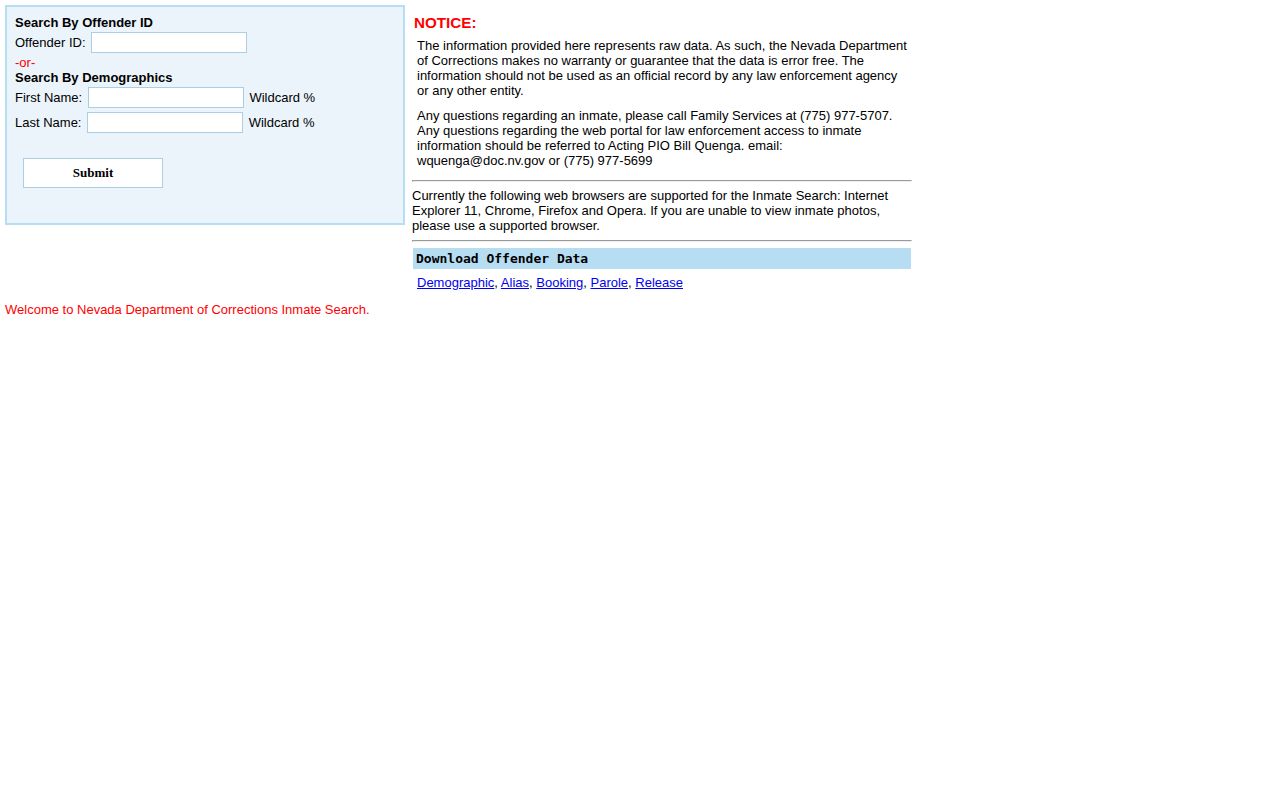
Use the identifier to reduce a same-name error, but seek an agency record when formal proof is needed.
Nevada Supervision Agency Contacts
NPP is the statewide field agency, while its offices route cases across Nevada. The central contact directory publishes a general number and regional office details. A county is useful for routing, but it does not always control the sentence. An Interstate Compact case may be supervised in Nevada under authority retained by another state, or a Nevada case may be supervised elsewhere. Ask the office to identify its role before treating a transfer as discharge.
Nevada State Police
Division of Parole and Probation
775-684-2600
Nevada Board of Parole Commissioners
Decision source for parole grants, denials, revocations, and early discharge actions.
NPP records are subject to the confidentiality rule and other lawful limits. A focused request should identify an existing record rather than ask staff to form a legal opinion. When the issue is a prison release event, NDOC remains the custodian of that event. When the issue is probation, the sentencing court record may be needed beside the NPP response.
The current NV S.A.V.E. system can also display custody or supervision wording for participating Nevada agencies. Its search and registration entry is shown here as a secondary notification channel, not as a replacement for NPP.
S.A.V.E. information can lag or depend on an agency feed, so confirm the status with the responsible office.
Nevada Supervision and Violations
Conditions are the rules attached to parole or probation. Their exact terms come from the controlling Board or court action and the supervision process. Public records should not be used to guess a condition. An alleged violation can lead to an inquiry, a warrant, a violation hearing, a modification, or revocation, but the allegation and final action are separate findings. The Board publishes distinct material for parole violation hearings because those proceedings concern alleged conduct after release, not a new eligibility hearing.
NPP also publishes Wanted Fugitives material. It is selective, not a statewide list of every person on supervision or every outstanding supervision warrant. Presence can support the listed status at the time of publication. Absence proves neither compliance nor discharge. Confirm the individual and the current legal action through NPP, the Board, and the court or warrant source as applicable.
- Absconder
- A person alleged to have stopped reporting or whose location is unknown under the supervision process.
- Revocation
- An official action ending or changing community supervision because of a sustained violation.
- Revoke and reinstate
- A Board outcome that addresses a violation but returns the person to supervision under the stated action.
- Detainer
- A notice that another authority may claim custody, even when one agency releases the person.
The S.A.V.E. notification selection illustrates Nevada choices for calls, email, and text tied to a matching record.
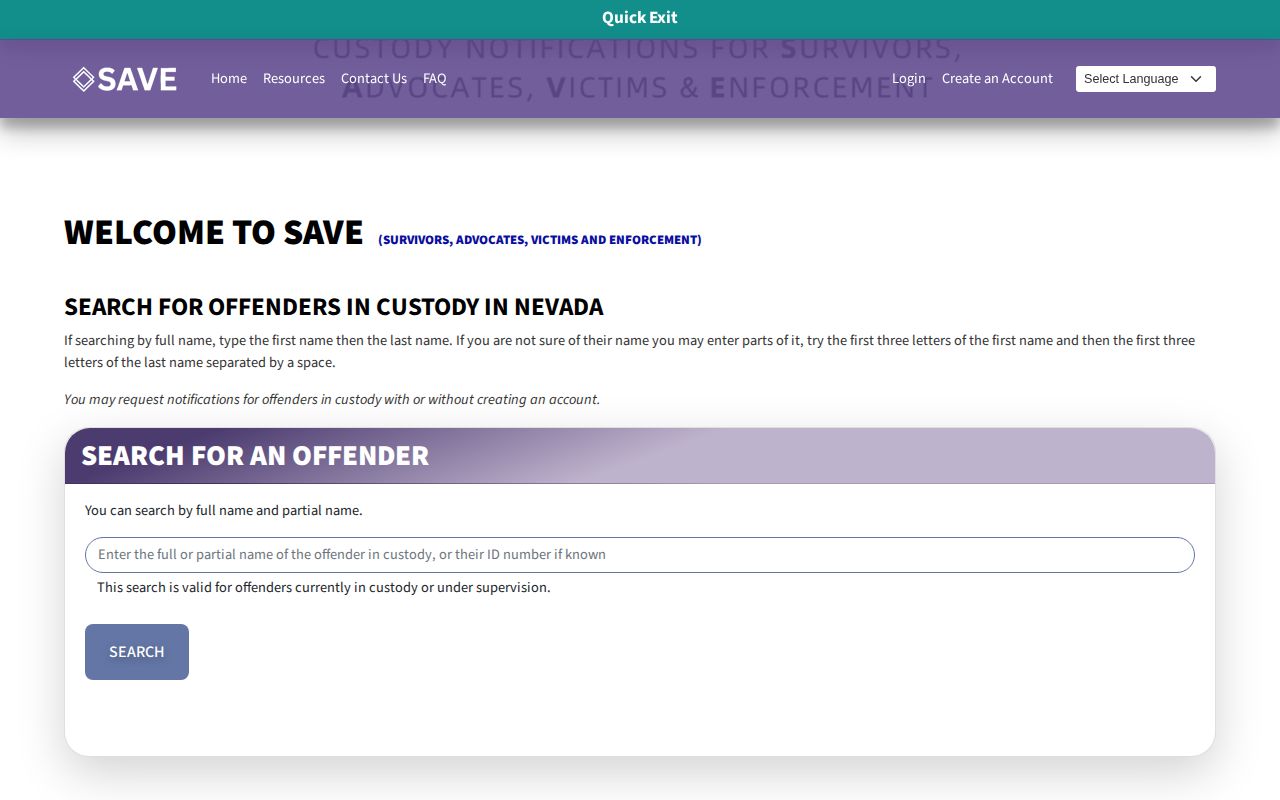
An alert is a prompt to verify the event. It is not an official NPP supervision record.
Note: A transfer, warrant, or short revocation can change location without ending the Nevada sentence or its supervision term.
Nevada Release Evidence Ladder
Nevada provides four documentable stages that are often collapsed into one. First, the Board action records what was decided. Second, the NDOC Release event records the movement from the prison placement. Third, NPP supports the period of active supervision. Fourth, a discharge certificate supports the end of supervision. This sequence is the statewide distinctive discharge-paperwork path. It prevents “released” from being mistaken for “sentence complete.”
The difference is visible in NDOC’s own event structure. Release and Parole are separate data categories, and an inactive institution label does not by itself state the whole disposition. The official released-result source shows the exact labels and identifiers available in a Nevada historical result.
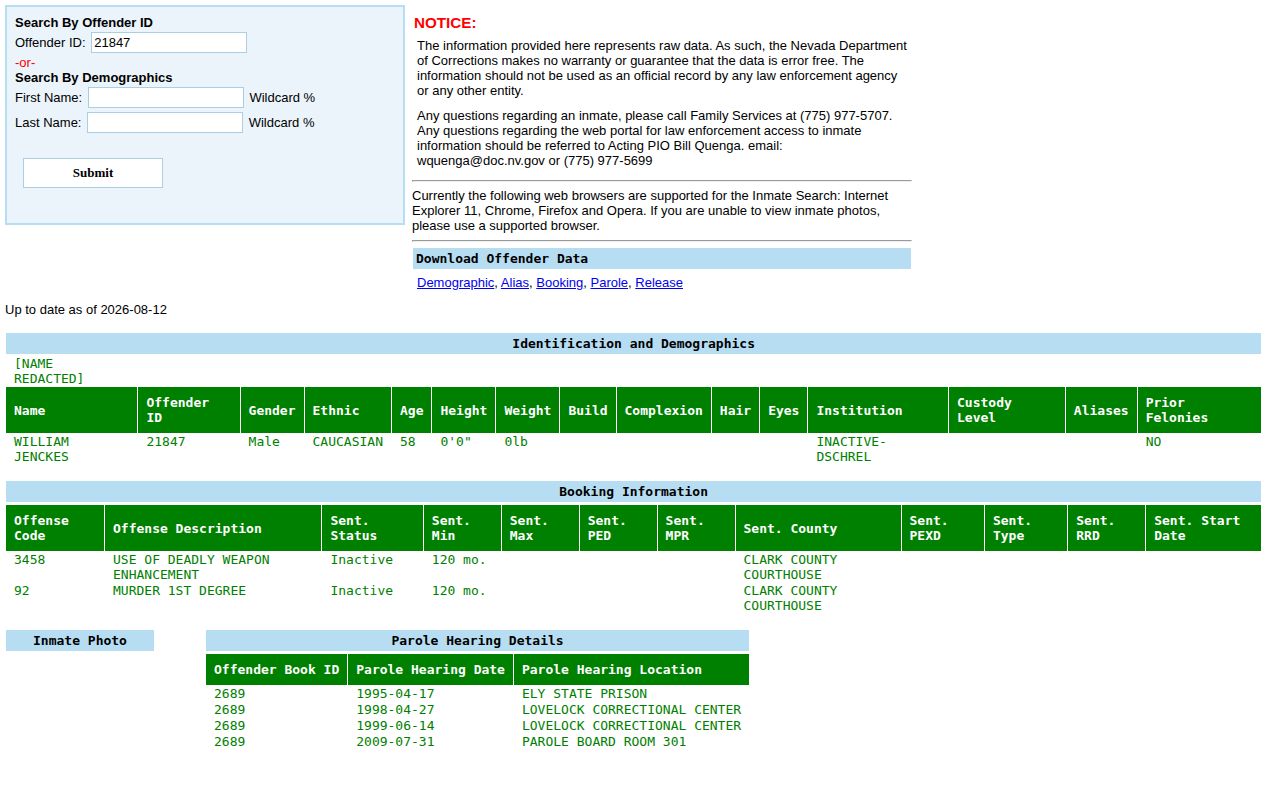
Copy the release description as displayed, then reconcile parole status and final discharge instead of converting every result to “free.”
The exact wording can identify a release for parole, a sentence discharge, a court-order movement, or another disposition. Nevada sentencing definitions also distinguish parole under supervision from completion of the prison sentence without community supervision. Those distinctions are why the latest dated movement must be read beside the supervision source. A release date answers when the prison placement ended. It does not answer by itself whether the maximum sentence ended, whether NPP opened a field case, or whether another authority assumed custody.
| Eligibility or Board stage | PED, NPED, schedule, and action answer when review may occur and what the Board decided. |
|---|---|
| Movement stage | The NDOC Release event answers whether and how the person left that correctional placement. |
| Supervision stage | NPP answers which office manages active parole or probation, subject to disclosure limits. |
| Discharge stage | The discharge document records the lawful end and the honorable or dishonorable classification. |
Nevada Supervision Discharge Documents
Supervision ends through the controlling sentence, court, or Board process. Under NRS 213.154, an honorable discharge is required when the term expires and the statutory conditions were fulfilled. The same section addresses dishonorable discharge when those conditions are not met, including specified circumstances involving unknown whereabouts or restitution. Unpaid restitution can remain as civil liability after discharge.
NRS 213.1543 creates an early-discharge recommendation path for certain qualifying parolees. The research criteria include time served in the community, projected time left, recent-violation status, payment or verified hardship, and completion of required treatment or programs. Lifetime supervision is excluded. This is a structured recommendation process, not an automatic end date.
Most concretely, NRS 213.155 requires an official document that records honorable or dishonorable discharge and applicable civil-right restoration dates. If that document was lost, damaged, or destroyed, the discharged person may submit a written request to a court of competent jurisdiction. After verification, the court issues an order without a fee. The statute supplies a direct proof route when a public web search cannot answer whether Nevada post-release supervision ended.
A discharge classification is not the same as record sealing. Nevada generally uses a court sealing process under a different chapter, and a discharge document does not make the prior Board, NDOC, or court history vanish. Keep the questions separate: the discharge document establishes the end and classification of supervision, while the court and record custodians control access to their own files. If the public sources show parole but no later discharge, ask for the existing discharge record rather than assuming the term expired.
For the broader distinction between prison movement and release status, the statewide Nevada released inmates search path identifies which custodian and record should be checked.
Nevada Supervision Record Limits
A supervision verification should stay narrow. Ask for the correct office, whether a public status can be confirmed, the effective date of an official action, and the route for an existing record. NRS 213.1075 limits disclosure of much information obtained in official duties. A refusal to provide an address, case notes, conditions, or contacts is not proof that the person is absent from supervision.
Automated results also have limits. S.A.V.E. depends on participating agency feeds, while NDOC describes its offender-search material as raw data rather than an official record. A court docket can show a probation order or revocation authority but may not show the exact time a custody movement occurred. Keep the query date, preserve exact labels, and ask the originating agency to resolve a true conflict.
Interstate Compact cases call for one more check. A Nevada office may perform day-to-day supervision for a sentence imposed elsewhere, while the sending state retains key authority. Nevada may also send a parolee or probationer to another state for field supervision. A move across the state line is therefore not discharge proof. Ask NPP which jurisdiction supervises in the field, which jurisdiction controls the sentence, and where an official end-of-supervision action would be recorded.
Public Record Search
Sponsored Results